1. Fundamentals of Cage Culture Aquaculture
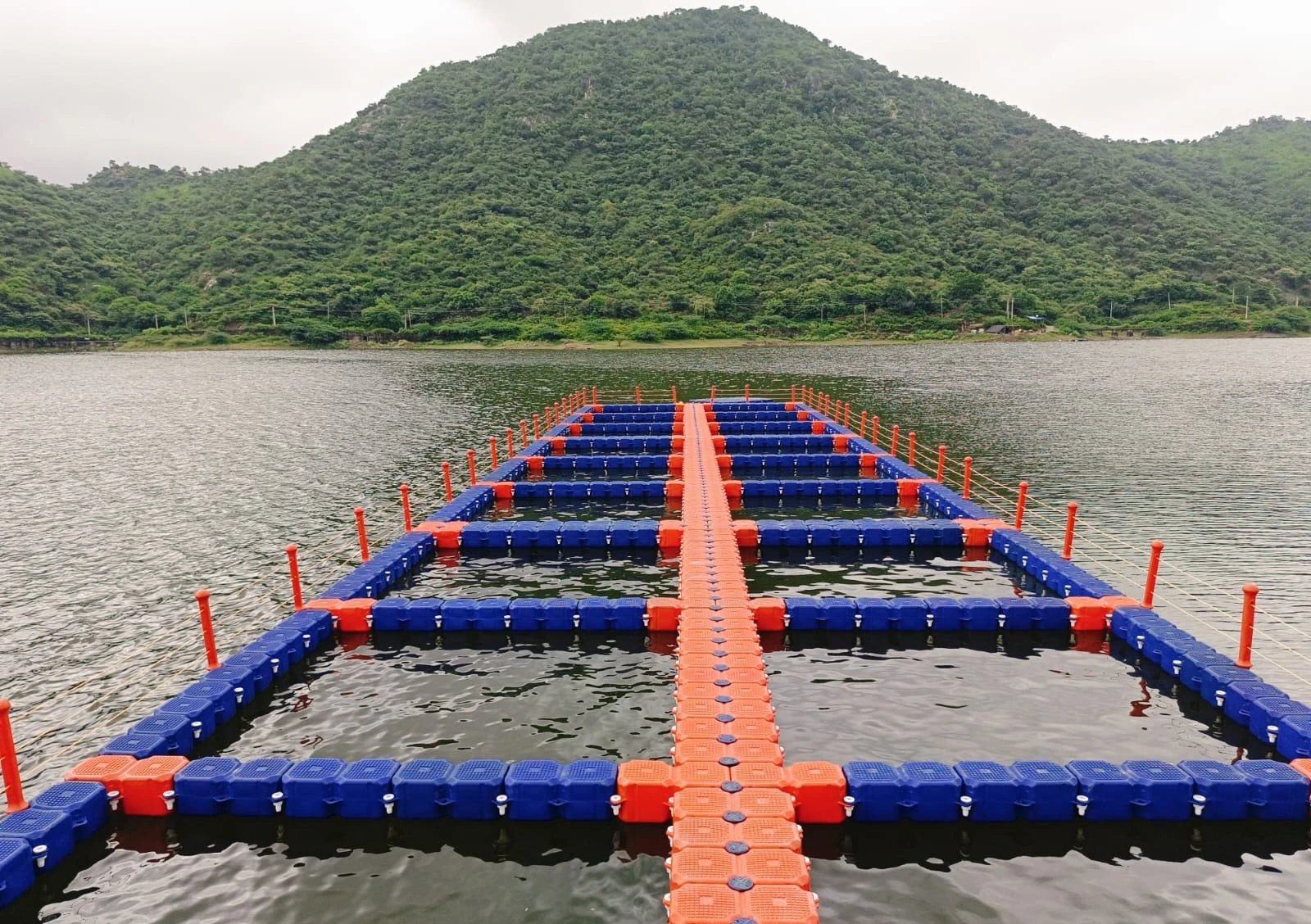
Cage culture is the practice of rearing aquatic organisms inside enclosed net bags held afloat by buoyant collar frames anchored to the seabed or reservoir floor. Unlike earthen ponds, which require significant land acquisition, extensive earthmoving, and active pumped water renewal, modern commercial fish farming cages leverage existing water bodies such as irrigation reservoirs, hydroelectric dams, and sheltered coastal inlets.
Free water exchange through the flexible netting continuously supplies dissolved oxygen to the stock while flushing away metabolic wastes. This dynamic environment supports significantly higher stocking densities per cubic meter than conventional pond culture, generating superior feed conversion ratios (FCR) and predictable harvest cycles.
2. Hydrographic Site Selection & Water Parameters
Selecting an appropriate water body is the single most critical factor determining biological survival and equipment integrity. Prior to procuring hardware, operators must audit the following physical and chemical benchmarks:
Crucial Water Quality Standards
- • Dissolved Oxygen (DO):Must remain strictly above 5.0 mg/L (ppm). Sub-4.0 mg/L induces acute feeding depression and immune stress.
- • Water Depth Clearance:A minimum of 5 to 7 meters depth. The net bottom must maintain at least 1.5 to 2.0 meters of clearance above the benthic mud to prevent anoxic sediment contamination.
- • Current Velocity:Optimal flow rates range between 0.1 m/s and 0.5 m/s. Stagnant water (<0.05 m/s) leads to local hypoxia, while excessive velocity (>1.0 m/s) deforms net bags and exhausts fish.
- • pH & Temperature:pH 6.5 to 8.5; stable water temperatures between 26°C and 32°C for warm-water species such as Tilapia and Asian Seabass.
3. Selecting the Right Cage Architecture
Cage structural designs fall into three primary commercial categories depending on hydrographic exposure:
A. Inland Modular Pontoon Cages
For inland reservoirs, lakes, and low-energy waterways, heavy-duty virgin HDPE aquaculture cages offer the highest operational efficiency. Built with modular pontoon walkways and handrails, they provide safe work decks for feeding and sampling. Standard dimensions such as 6x4x4 m and 7.5x4 m allow high volumetric stocking of GIFT Tilapia, Pangasius, and Indian Major Carps.
Explore HDPE Cage Specifications →B. Circular Marine & Coastal Cages
Exposed marine bays subject to ocean swells and strong tidal rips demand hydrodynamically compliant circular coastal cages. Manufactured with dual-ring continuous HDPE extruded pipes, these pens dissipate wave forces uniformly and maintain high internal net volume for pelagic marine species such as Asian Seabass (Barramundi), Cobia, and Pompano.
Explore Circular Coastal Cages →C. Integrated Mariculture Floating Systems
Commercial operations scaling across multiple hectares require central operations hubs. Integrating modular mariculture floating systems provides offshore staging areas, feed storage depots, and worker resting platforms with 350+ kg/m² load capacity.
Explore Floating Platform Systems →4. Stocking Management & Feeding Protocols
Fingerling quality determines the trajectory of any cage culture enterprise. Never stock stunted or diseased seed. For genetically improved farmed Tilapia (GIFT), stock fingerlings weighing at least 15 to 25 grams into nursery cages before transferring to grow-out pens.
Target stocking densities typically range from 40 to 65 fish per cubic meter depending on water exchange velocity and aeration backup. Feeding must utilize extruded floating pellets formulated with high-quality marine proteins and essential amino acids (28% to 32% crude protein for omnivorous species; 40% to 45% for carnivorous marine finfish). Floating pellets allow operators to monitor feeding vigor visually, preventing feed wastage that drives up costs and degrades local water chemistry.
5. Capital Setup Considerations & B2B Planning
When structuring a commercial business plan, divide expenditures into Capital Expenditure (CAPEX) and Operational Expenditure (OPEX). CAPEX includes HDPE pontoon frames, netting batteries (nursery, grow-out, predator net, bird net), mooring anchors, marker buoys, and service skiffs. Because virgin PE100 HDPE structures last 15 to 20 years, capital depreciation per crop cycle remains minimal.
OPEX is dominated by commercial feed (60% to 70% of production costs), quality fingerling procurement, labor, and regular biofouling maintenance. State and central government schemes under the Pradhan Mantri Matsya Sampada Yojana (PMMSY) provide financial subsidies for cage culture infrastructure in reservoirs across India, significantly de-risking initial capital deployment for qualified enterprises.